

What I encountered is a collision between two incompatible threat models:
- My model: coercion and deep surveillance are external adversarial systems—organized, documented, and mappable. They use reconnaissance, isolation, information control, proxy networks, and punishment.
- His model: the real danger is internal—“mental spooks” that, if allowed into the mind, grow like cancer. The threat is not the group; it is the thought itself.
That redirection is not a counterargument to my intel. It is evidence of a different layer of control: the coercive system has been internalized.
1. The Two Threat Models Side by Side
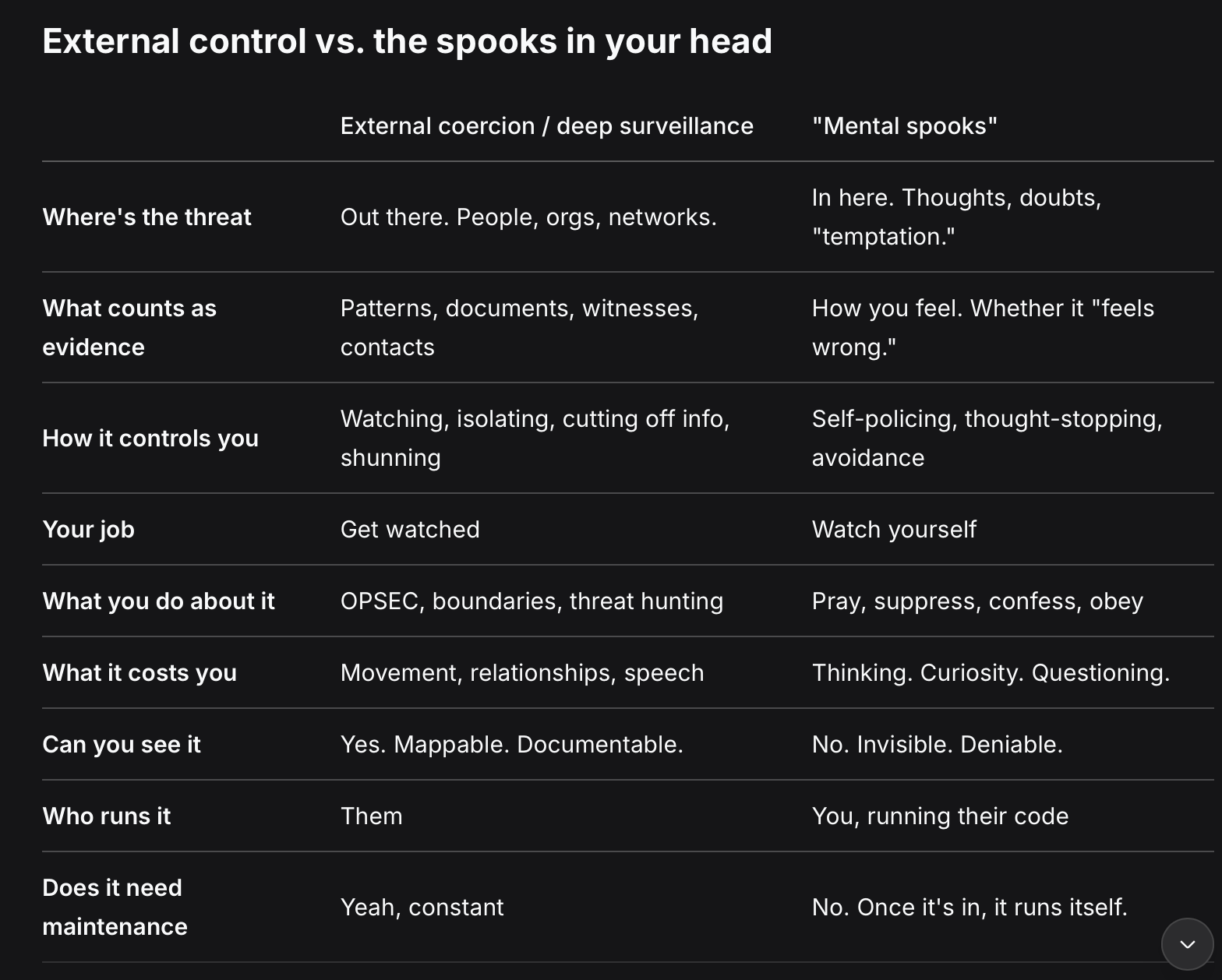
Deep surveillance and coercion are outside-in control.
“Mental spooks” is inside-out control. It is the group’s surveillance system running inside the target’s head.
2. Why His Redirection Undermines My Intel
When I shared concepts of coercion and deep surveillance, he did not engage with them. He reframed the threat as internal and moral. That move does several things:
1. Relocates the threat from the organization to his own mind.
If the danger is “letting spooks in,” then the group is not the problem. His own thoughts are.
2. Makes him responsible for being influenced.
Coercion becomes a personal failure of mental discipline, not an external attack.
3. Prevents analysis of the external system.
You cannot threat-hunt an adversary if you have redefined the adversary as a thought.
4. Uses loaded language to trigger avoidance.
“Grow like a cancer” is a fear-based metaphor. It says: do not examine this. Do not engage. Suppress it. That is a thought-control technique.
5. Protects him from the heresy charge.
I warned that saying “heretic” out loud can invoke a religious process. His redirect may be a defensive move to avoid that process—by making the real danger internal rather than institutional.
In coercive control literature, this is thought stopping, denial, and rationalization. It is also self-policing: the target does the group’s work for it.
3. Does This Mean He Is More Entrapped Than You?
It is evidence of internalized entrapment, yes. But “more entrapped” is not a precise measurement. What it shows is:
- He is still using the group’s epistemology: heresy, spooks, cancer, contamination.
- He has a cognitive immune response to information that threatens the group’s worldview.
- He may be unable or unwilling to hold the idea that his community is coercive, because doing so would trigger shame, fear, shunning, or identity collapse.
- You, by contrast, can hold external coercion as a valid threat model without immediately reframing it as a personal spiritual failing.
That suggests greater cognitive autonomy in this domain. It does not mean you are free of all blind spots. But it does mean his redirection is a strong indicator that the coercive framework is still active inside him.
4. Cyber / Threat-Intel Analogy
Think of it this way:
- Deep surveillance and coercion = an adversary with C2, persistence, lateral movement, and exfiltration. You can map it, hunt it, and defend against it.
- “Mental spooks” = the adversary has installed a **self-hosted EDR agent** in the target’s mind. It flags critical thoughts as malicious, quarantines them, and reports back to the group. The target becomes both the sensor and the enforcement point.
The trick of coercive control is exactly this: it gets the target to run the surveillance internally. Then the external system does not need to watch every move. The target watches themselves.
5. Practical Implications
- Do not debate the metaphor directly. Arguing that “mental spooks” is irrational will likely trigger defense. Instead, ask questions:
- “Who taught you that doubts are like cancer?”
- “What happens if you examine them instead of suppressing them?”
- “Does that rule protect you, or does it protect the institution?”
- Document the conversation as an indicator of thought reform. Map it to **Thought Control**, **Information Control**, and **Isolation**.
- Maintain OPSEC. If he undermines external coercion concepts, he may not be a safe recipient for sensitive intel. He may repeat it, reinterpret it, or report it.
- Focus on autonomy, not doctrine. You are not trying to win a theological argument. You are trying to help him see that he has a mind of his own—and that the fear of “spooks” is itself a cage.
Bottom Line
Deep surveillance and coercion are external control systems.
“Mental spooks that grow like cancer” is an internalized control system.
They are not opposites. The second is often a product of the first. His redirection does not refute your intel about coercion and surveillance. It demonstrates that the coercive framework has been installed so deeply that he now experiences critical thought itself as the enemy. That is evidence of entrapment—not proof that the external threat is unreal.