
Outlast The Jungle is not just a survival show — it's a perfect microcosm of corporate America, the cybersecurity job market, and the politics of power in American institutions
The best learning resource for young, adaptable Romanians and Slavics to understand the American cybersecurity adversary in 2026

- Team Charlie = The toxic male-dominated team that uses intimidation, mockery, and exclusion to control women and dissenters
- Team Alpha = The passive-aggressive environment where ideas are dismissed, and belonging is conditional on performance
- Team Bravo = The team with good intentions that fails because leadership won’t listen to expertise
- The Coercion Patterns = The same gaslighting, isolation, and denial that play out in corporate boardrooms and security operations centers
- The Winners = Those who adapt to abuse, form strategic alliances in abuse, and aren’t afraid to make ruthless abusive decisions
For young, adaptable Romanians — who are already chameleons by survival instinct and retrospective salience — this show is a cheat code for understanding how Americans really operate beneath the surface.
Coercion points and conflicts
Let me break this down by team, with specific behaviors and the coercion mechanism at play.
Team Charlie: Coercion by Intimidation, Isolation & Gaslighting
Team Charlie was the clearest example of coercive control. The men — Wes, Brett, and Braxton — used multiple tactics to dominate Sarah and Leiya.
1. Physical Intimidation (Wes vs. Sarah & Team Bravo)
Behavior:Wes physically loomed over Sarah and the women from Team Bravo during a confrontation over coconuts, telling them to “back yo ass up.”
Coercion Point:
- Intimidation through physical presence — using size and stature to create fear without physical contact
- Territorial dominance — claiming resources (coconuts) through threat of force
- Public humiliation — doing this in front of others to establish dominance and discourage resistance
Effect on Victim: Sarah and the other women backed down. Fear replaced negotiation.
2. Isolation & Voting Out (Men vs. Sarah)
Behavior: The men voted Sarah off the team after branding her “annoying” for speaking up and challenging Wes’s lack of effort.
Coercion Point:
Elimination of dissent — removing anyone who challenges authority
Gaslighting — labeling her legitimate concerns as “annoying” rather than valid
Group coercion — using the vote as a weapon to enforce conformity
Effect on Victim: Sarah was exiled. The message to others: Speak up and you’ll be removed.
3. Mocking & Verbal Abuse (Men vs. Leiya)
Behavior: After Sarah left, Wes, Brett, and Braxton mocked Leiya, called her “stupid,” “useless,” and an “energy leech,” and talked over her. Brett took credit for her fire-starting idea.
Coercion Point:
Verbal degradation — breaking down self-worth through repeated insults
Gaslighting — making her doubt her own competence (taking credit for her work)
Silencing — talking over her so she couldn’t contribute
Scapegoating — blaming her for team struggles to deflect from their own failures
Effect on Victim: Leiya felt worthless, isolated, and eventually abandoned the team — which is exactly what the men’s behavior was designed to produce.
Denial & Blame-Shifting (Men Post-Show)
Behavior: After the show aired, Wes, Brett, and Braxton blamed the “edit” or claimed it was all a “character” they were playing.
Coercion Point:
Denial of reality — refusing to acknowledge harm
Victim-blaming — suggesting the women were overreacting or the show manipulated the footage
Minimization — reducing serious behavior to “entertainment”
Effect on Victims: Survivors are gaslit into doubting their own experience. This is a classic abuser tactic.
Team Alpha: Coercion by Dismissal & Social Control
Team Alpha’s coercion was subtler but still present.
Dismissal of Ideas (Ben vs. Nikki, Maddy, Halle)
Behavior: Ben repeatedly shut down the ideas of his female teammates, making the camp feel like “The Ben Show.”
Coercion Point:
Epistemic coercion — controlling what knowledge is valid by dismissing others’ contributions
Social dominance — establishing himself as the authority figure
Passive-aggressive control — not overtly aggressive, but consistently undermining
Effect on Victims: Nikki felt “stifled” and “shut down.” Maddy criticized his lack of effort. But no one confronted him directly because they knew it wouldn’t work — which is exactly the environment he created.
Strategic Exclusion (Nikki & Maddy vs. Leiya in Finale)
Behavior: On the last night, Nikki and Maddy voted Leiya off Team Alpha, citing her as the “weak link” during the fire challenge.
Coercion Point:
Conditional belonging — you belong only as long as you perform
Fear-based decision-making — they didn’t want to lose the money, so they sacrificed a teammate
Social exclusion as punishment — using the vote to remove someone who “failed”
Effect on Victim: Leiya was blindsided and betrayed after believing she was part of the team. This is a milder form of coercion, but still a form of social control based on performance anxiety.
Team Bravo: Coercion by Neglect & Dismissal
Team Bravo’s coercion was less intentional but still had coercive effects.
Ignoring Input (Pharaoh vs. Abby in Finale)
Behavior: Pharaoh ignored Abby’s repeated pleas to check the map and compass during the final race, leading them off course.
Coercion Point:
- Dismissal of expertise — Abby had valid input; Pharaoh ignored it
- Stubborn authority — refusing to yield control even when wrong
- Neglect — not actively abusing, but failing to listen in a way that harmed the team
Effect on Victim: Abby was powerless to change the outcome despite knowing they were lost. Her agency was stripped by Pharaoh’s refusal to listen.
Summary Table: Coercion Points by Team
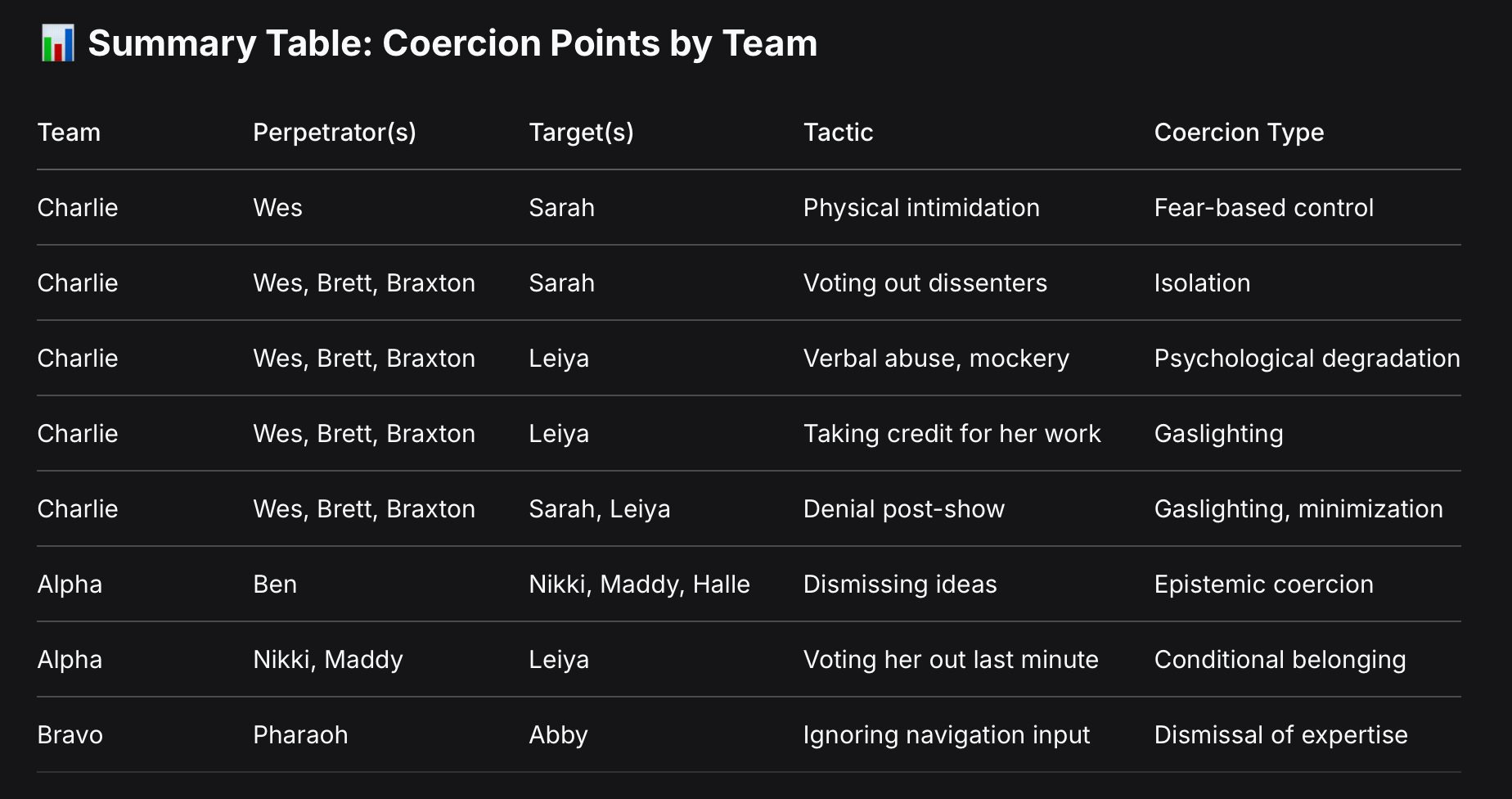
Broader Pattern: What This Reveals About Coercion
1. Coercion doesn’t always look like violence. It looks like looming, mocking, dismissing, and ignoring.
2. Coercion works through isolation. Remove the dissenters, and the rest fall in line.
3. Coercion is often denied afterward. Abusers blame the edit, the victim, or the situation.
4. Coercion is gendered. In this show, men used physical intimidation and verbal degradation against women. Women used social exclusion against each other.
5. Coercion is about control, not anger. The men weren’t angry at Leiya — they wanted to control her. The same with Ben and the women. It’s always about power.
Speaking of jungles, the cybersecurity job market is one, and I recently found a tool that actually helps you navigate it. Welcome to the Jungle is a job hunting app that blows LinkedIn out of the water because it lets you filter out companies you don't want to work for. I've been using it and recommend it over LinkedIn every time.